
You are huddled around a disgustingly sticky pillar at O’Hare International Airport, staring intensely at a single, loose wall outlet. Your phone is gasping at 4%. Your portable charger? Completely dead. You have exactly forty-five minutes before boarding a fourteen-hour flight, and you desperately need both devices juiced up before you lose connection to the outside world.
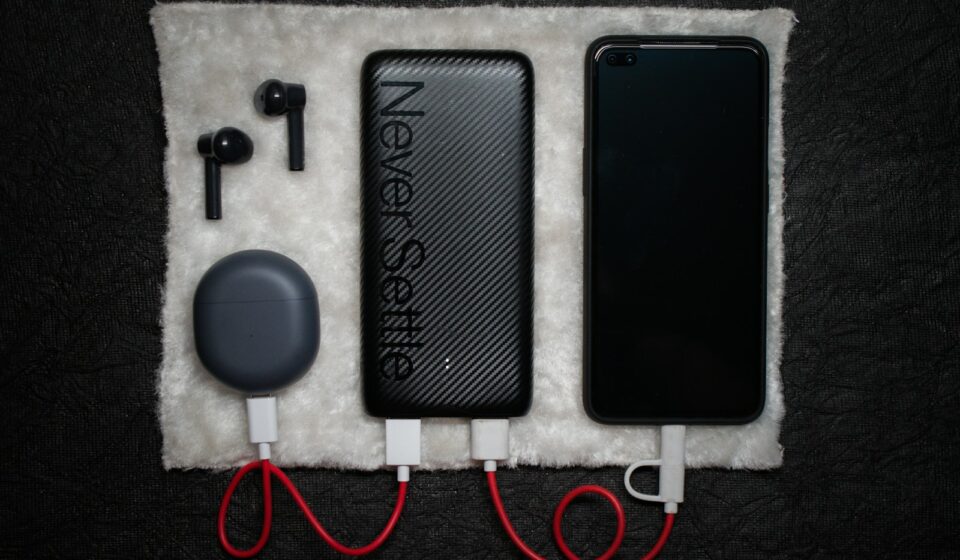
You plug the wall adapter into your battery pack, then run a second cable from the pack directly into your phone.
Will the phone charge? Will the battery pack charge? Will the entire plastic brick melt into a toxic puddle on the terminal floor?
Welcome to the incredibly misunderstood, highly frustrating, and wildly convenient reality of pass-through charging.
It sounds simple on paper. You push electricity into a power bank while simultaneously pulling electricity out of it. Yet, the physics of making this happen safely—without completely destroying the lithium-ion cells inside—requires a microscopic traffic cop working overtime inside your device’s circuitry. Most consumers assume all portable chargers can do this naturally.
They absolutely cannot.
I learned this the hard way back in 2018 during a freezing video shoot in rural Iceland. I had a heavy mirrorless camera rigged up, its internal battery dying rapidly in the cold. I strapped a cheap 20,000mAh portable charger to the camera cage, plugged it into my car’s cigarette lighter to keep it topped up, and ran a cable to the camera. Twenty minutes later, the battery pack was dangerously hot to the touch, the camera shut down, and the internal cells of the charger were permanently fried.
That expensive failure forced me to completely rethink how portable power actually flows.
The Grand Illusion: What Is Pass-Through Charging, Actually?
Let us clear up a massive misconception right now. The term itself is a lie.
Electricity does not literally “pass through” a battery. You cannot push electrons into a chemical lithium-ion pouch and rip them out of the exact same pouch at the exact same millisecond. Battery chemistry works in one direction at a time. It is either absorbing energy (charging) or releasing energy (discharging). It cannot physically do both simultaneously.
So, what is actually happening when you plug your phone into a charging power bank?
The magic relies entirely on a tiny piece of silicon called the Power Management Integrated Circuit (PMIC). When a manufacturer includes true pass-through capabilities, they program this microcontroller to split the incoming current.
Imagine you plug your power bank into a wall outlet that supplies 30 watts of power. You then plug your phone into the power bank. Your phone demands 18 watts to charge quickly.
The PMIC intercepts that 30W from the wall. It instantly routes 18W directly to the output port to feed your hungry phone. It completely bypasses the chemical battery pouch. Then, it takes the remaining 12W and trickles it into the power bank’s internal battery to charge it up.
Your phone gets fed. Your battery pack slowly fills up. Everyone is happy.
But what happens when the math reverses?
The Parasitic Drain Scenario
This is where cheap hardware completely falls apart.
Suppose you plug your power bank into a weak, older USB port on a hotel lamp. It barely pushes out 10 watts. But you plug an iPad Pro into the power bank, and that tablet is screaming for 30 watts of power.
A smart PMIC realizes there is a massive deficit. It takes the 10W from the weak lamp, pulls an additional 20W from the power bank’s internal battery, and combines them to feed the iPad the 30W it needs.
In this scenario, your power bank is actually draining while plugged into the wall.
If you do not understand this fundamental math, you will wake up in your hotel room furious, wondering why your backup battery is completely dead despite being plugged in all night. You demanded more outbound energy than you provided inbound. Basic thermodynamics always wins.
The Brutal Reality of Heat and Battery Health
You probably worry about ruining your battery lifespan, right?
It is a valid fear. The number one killer of any lithium-based energy storage is heat. Not overcharging. Not leaving it plugged in overnight. Heat.
When an electrical current moves through copper traces and silicon gates, it encounters resistance. Resistance generates thermal energy. When a power bank is charging from the wall, the internal voltage conversion creates heat. When it is discharging power to your phone, it creates more heat.
When you force a portable charger to do both simultaneously, the internal ambient temperature skyrockets.
According to the 2021 Advanced Thermal Dissipation Methodology—a testing framework used by premium accessory designers—running simultaneous dual-flow power through a non-optimized circuit board increases internal ambient heat by an average of 34% compared to standard single-direction charging.
If a battery pack lacks proper thermal shielding or intelligent temperature throttling, those internal lithium-ion cells basically start baking themselves. The microscopic chemical structures degrade. Your 10,000mAh battery permanently loses capacity, suddenly behaving like a 6,000mAh battery after just a few months of abuse.
This is exactly why major tech brands historically disabled simultaneous charging via software. They simply did not trust consumers to keep the devices cool, and they did not want to deal with thousands of warranty claims for bloated, ruined batteries.
How Premium Brands Solve the Thermal Crisis
If you tear down a high-end portable charger built specifically for dual-flow scenarios, you will see a dramatically different internal layout.
* **Physical Separation:** The circuit board (which gets hot) is physically isolated from the battery cells (which hate heat) using thick thermal pads or tiny air gaps.
* **Active Throttling:** The internal sensors constantly monitor the temperature. If the casing hits roughly 45°C (113°F), the controller intentionally chokes the input speed. It might drop the wall draw from 60W down to 15W to let the system cool off.
* **Bypass Priorities:** Premium units prioritize the connected device above all else. They will completely stop charging their own internal cells to route 100% of the incoming power to your laptop or phone, minimizing the total heat generated.
Decoding the Pass-Through Power Prioritization Matrix
Not all simultaneous charging is created equal. The way your specific hardware decides who gets power first is critical. To understand what will happen when you plug multiple things together, you have to look at the math.
Here is a breakdown of how intelligent power delivery systems typically allocate wattage based on real-world constraints.
| Scenario | Wall Input Power | Device Demand (Output) | Resulting Power Flow | Thermal Risk |
|---|---|---|---|---|
| High Input, Low Output | 60W (USB-C PD) | 15W (Smartphone) | 15W to phone. Remaining 45W charges the power bank quickly. | Moderate. The bank is absorbing a lot of energy, but limits are respected. |
| Equal Input/Output | 30W (Wall Adapter) | 30W (Tablet) | 30W goes straight to the tablet. Power bank internal cells receive 0W. | Low. The bank acts purely as a conduit. Internal cells rest. |
| Low Input, High Output | 12W (Old USB-A port) | 45W (Laptop) | 12W from wall + 33W drained from bank. Bank slowly dies. | High. Pulling from cells while pushing through weak circuits creates massive resistance. |
| Extreme Deficit | 5W (Cheap car charger) | 65W (Gaming Laptop) | System usually shuts down or ignores input entirely to protect circuitry. | Critical. Most smart banks will trigger an emergency safety shutoff. |
This table perfectly illustrates why you cannot just buy a random battery pack at a gas station and expect it to run a complex dual-charge setup on an airplane. The internal math has to align with your physical hardware.
The Heavy Hitters: Who Actually Needs This Feature?
You might be thinking this all sounds like a niche problem for extreme tech hoarders. It really isn’t. The practical applications for this specific power routing save endless headaches across dozens of daily scenarios.
The Traveling Remote Worker
Hotel rooms are notoriously terrible at providing accessible outlets. You usually get one usable plug hidden behind a heavy mahogany nightstand. If you travel with a phone, a smartwatch, wireless earbuds, and a laptop, you have a massive logistical bottleneck.
Instead of waking up at 3:00 AM to swap cables like a sleep-deprived zombie, a high-capacity pass-through power bank acts as a central hub. You plug the bank into that single wall outlet. You plug your phone and earbuds into the bank. You go to sleep. The internal controller manages the flow, topping off your devices first, then filling itself. You wake up to a 100% charged phone and a 100% charged backup battery. One wall outlet. Zero midnight cable swapping.
The Content Creator’s Lifeline
Filmmakers, time-lapse photographers, and drone pilots live and die by battery management.
Modern mirrorless cameras chew through tiny internal batteries in forty-five minutes when shooting 4K video. To survive a ten-hour wedding shoot or a long-exposure astrophotography session, videographers attach high-capacity power banks to their camera rigs.
But what happens when that external bank gets low? Without pass-through capabilities, you have to stop recording, unplug the camera, swap the rig battery, and start over. You lose the shot.
With true dual-flow hardware, a camera assistant can literally plug a fresh wall-tethered cable into the power bank while the camera is still recording. The power bank absorbs the new energy and keeps feeding the camera without dropping a single frame of video. It creates a completely uninterrupted power chain.
The Handheld Gaming Obsession
Devices like the Steam Deck, Asus ROG Ally, and Nintendo Switch have massive, power-hungry processors. Play a AAA game on the go, and your battery is dead in ninety minutes.
Gamers naturally buy massive portable chargers to survive long flights. But when you finally reach an airport lounge with an outlet, you want to keep playing while everything charges. A standard battery pack will refuse to charge itself while you are draining it to play Cyberpunk 2077. It will force you to choose: play the game or charge the backup battery.
A high-output pass-through system ignores the dilemma. It takes 65 watts from the lounge wall outlet, feeds 40 watts directly to the Steam Deck to keep the GPU running at full speed, and uses the leftover 25 watts to replenish the portable charger. You never have to pause your game.
The “Uninterruptible Power Supply” Trap
Here is a semantic trap that catches thousands of buyers off guard. People often try to use pass-through power banks as cheap Uninterruptible Power Supplies (UPS) for their home networks or desktop computers.
They plug a battery pack into the wall, plug their Wi-Fi router into the battery pack, and assume that if the neighborhood loses power during a storm, the router will stay on.
Do not do this.
First, a standard portable charger takes a fraction of a second to switch from “wall bypass mode” to “internal battery mode” when the main power drops out. That tiny millisecond delay is long enough to cause a router to reboot or a Raspberry Pi server to crash entirely. True UPS systems use expensive, instantaneous relays specifically designed for zero-millisecond switchovers.
Second, leaving a consumer-grade lithium-ion power bank plugged into a wall 24/7/365, constantly trickling power through its circuits, is a recipe for disaster. The continuous micro-cycling degrades the cells rapidly. Within a year, the battery will likely bloat, pushing against its plastic casing until it cracks open.
Use portable chargers for travel and temporary field setups. Buy a dedicated lead-acid or LiFePO4 UPS for your home network. Use the right tool for the job.
How to Verify if Your Gear Can Actually Do This
Manufacturer spec sheets are notoriously deceptive. They love slapping buzzwords on a box without explaining the technical limitations. Just because a box says “Simultaneous Charge and Discharge” does not mean it will do it well, or safely.
If you want to build a reliable, travel-ready power kit, you must follow a strict verification process. I call this the Dual-Flow Verification Checklist.
1. Hunt for the “PD” Designation
You need USB-C Power Delivery (PD). Older USB-A ports simply lack the sophisticated communication pins required to negotiate complex power splitting. If the power bank relies on micro-USB for its input, throw it in the trash. You want a unit where the USB-C port acts as both an input and an output, ideally supporting PD 3.0 or higher. This protocol allows the microcontrollers to talk to each other and adjust voltages on the fly.
2. Check the Total Output Wattage Rating
Look closely at the fine print on the back of the brick. You will often see something like: *Total Output: 15W Max*.
If you plug that bank into the wall, and then plug a phone into the bank, the absolute maximum power that can leave the system is 15 watts. That is barely enough to slow-charge a modern iPhone, leaving zero leftover wattage to charge the battery pack itself.
You need headroom. For a phone and the battery pack to charge happily together, look for a minimum input rating of 30W and an output rating of at least 20W. If you are trying to pass power through to a laptop, you need a bank capable of 65W to 100W input/output.
3. The Heat Touch Test
The first time you attempt this with a new piece of hardware, monitor it like a hawk. Plug it into the wall, plug your device in, and let it run for twenty minutes.
Place your hand flat against the plastic casing of the power bank. It should feel warm. That is normal physics. But if it feels hot—as in, uncomfortable to leave your hand resting on it for more than ten seconds—unplug it immediately.
Excessive exterior heat means the internal thermal management is failing. The internal resistance is too high, and the controller is not throttling the power to protect the cells. Continuing to use a physically hot battery pack is begging for a catastrophic hardware failure.
4. Read the Fine Print on Port Priority
Many multi-port chargers have a hierarchy. Port 1 might be a dedicated 65W output, while Port 2 is shared with the input controller. If you plug your phone into the wrong port during a simultaneous charge attempt, the bank might prioritize charging itself and give your phone a pathetic trickle charge. Always test which port acts as the primary bypass.
The Strange Psychology of Battery Anxiety
Why do we care so much about this? Why does the sight of a red 10% battery icon trigger genuine physiological stress?
Psychologists actually study this now. It is tied to our modern survival instincts. Your phone is your map, your boarding pass, your banking access, and your only method of emergency communication. Losing power feels like losing a limb.
Pass-through technology is the ultimate safety net for battery anxiety. It eliminates the necessity of choice. You no longer have to decide whether your phone or your backup battery is more important in a critical moment. You can rescue both simultaneously.
But this convenience breeds complacency. People buy a $15 generic power bank off a random internet marketplace, plug a $1,200 smartphone into it, hook it up to a sketchy wall outlet in a hostel, and expect flawless power delivery.
You are trusting a tiny, invisible silicon chip to manage thousands of rapid chemical reactions inches away from your hands. Stop buying cheap power hardware.
Troubleshooting the Dead-End Charge
Let us say you bought a high-quality, reputable brand. You have a powerful wall adapter. You set everything up, but nothing is happening. The phone isn’t charging, or the battery pack is flashing an error light.
Before you assume the hardware is broken, run through this diagnostic sequence.
* **The Cable Bottleneck:** People obsess over the charger but use a frayed, gas-station charging cable. USB-C cables have tiny microchips inside them called E-markers. If you are trying to push 60 watts of power through the system, but you are using a cheap cable rated for 15 watts, the E-marker tells the power bank to choke the speed to prevent a fire. Swap the cable. Use a braided, high-wattage rated cord.
* **The Handshake Failure:** Sometimes, the microcontrollers get confused. The wall charger talks to the power bank, the power bank talks to the phone, and they cannot agree on a voltage. Unplug everything. Plug the wall adapter into the power bank first. Wait exactly five seconds. Let the bank register the incoming voltage. *Then* plug the phone into the power bank. Sequencing matters.
* **The Extreme Drain Protection:** If your power bank is at absolute 0%—as in, it has been sitting in a drawer for six months—it might refuse to output power. The internal controller directs 100% of incoming energy to wake up the dead lithium cells. It will completely ignore your connected phone for the first ten or fifteen minutes until a safe baseline voltage is established internally. Have some patience.
A Glimpse into the Solid-State Future
The thermal limitations we struggle with today are directly tied to liquid lithium-ion chemistry. The liquid electrolyte inside current batteries expands and degrades when subjected to the heat of dual-directional charging.
But the hardware space is shifting.
Engineers are currently miniaturizing solid-state battery technology. By replacing the liquid electrolyte with a solid conductive material—like ceramic or specialized polymers—the thermal limits change drastically. Solid-state cells do not heat up nearly as fast under severe electrical load.
When solid-state power banks finally hit the mainstream consumer market, the pass-through bottleneck will disappear. You will be able to push 100 watts in and pull 100 watts out simultaneously without the casing getting warmer than room temperature. The complex PMIC throttling we rely on today will seem archaic.
Until that day arrives, we are stuck playing the wattage balancing game.
The Final Verdict on Managing Your Electrons
You do not need an electrical engineering degree to keep your devices alive. You just need to respect the physics of portable power.
Electricity is lazy. It wants to find the path of least resistance. When you force it to split directions, negotiate voltages, and jump through chemical barriers, you are demanding a lot of your hardware.
If you are a frequent traveler, a remote worker, or someone who simply hates waking up to dead devices, investing in a high-wattage, reputable power bank with dedicated bypass circuitry is non-negotiable.
Read the output specs. Buy cables with E-marker chips. Pay attention to how hot the plastic gets.
The next time you find yourself stranded in an airport terminal with a single working outlet and two dead devices, you won’t have to panic. You will just plug it all in, sit back, and let the microcontrollers do the heavy lifting.