
Standing on the corner of Sixth Avenue and 53rd Street in Manhattan, clutching a beige, brick-shaped piece of plastic that weighed roughly two and a half pounds. It was April 3, 1973. The wind was probably biting, as New York springs tend to be, but Martin Cooper wasn’t thinking about the weather. He was holding the Motorola DynaTAC prototype—a spectacularly clunky, entirely absurd piece of hardware by today’s standards—and he was about to make a phone call that would permanently alter human communication.
He didn’t call his wife. He didn’t call the president.
He called his direct competitor.
Cooper dialed the number for Joel Engel, the head of research at Bell Labs, AT&T’s legendary engineering division. When Engel answered, Cooper essentially said: I’m calling you from a real cellular telephone. A personal, handheld, portable cell phone. History doesn’t record Engel’s exact facial expression in that moment, but it’s safe to assume it wasn’t a smile. Bell Labs had been chasing this exact prize for decades. They had the budget, the monopoly, and the brightest minds in telecommunications. Yet, a scrappy team at Motorola beat them to the punch. It’s a brilliant, petty, deeply human moment—the exact kind of friction that drives technological leaps, right?
If you’ve ever tried lugging around a first-generation portable transceiver from the late eighties, you already know the distinct, shoulder-aching reality of early cellular communication. I remember tearing apart a busted, water-damaged Motorola MicroTAC back in ’98. I sat at my workbench staring at the painfully primitive, thick green circuit boards, wondering how this heavy monstrosity ever managed to push a radio signal through two miles of dense urban concrete. The sheer power required was staggering. We complain today when our sleek glass slabs drop a bar of 5G, but back then? Getting a dial tone while walking down the street felt like performing actual magic.
The Pre-History: Car Phones and the 80-Pound Trunk Monsters
To really grasp when cellphones were invented, we have to rewind much further back than 1973. You can’t just look at the first handheld device and ignore the massive, invisible radio infrastructure that made it possible.
Following World War II, right around 1946, AT&T launched the Mobile Telephone Service (MTS) in St. Louis, Missouri. People love to casually drop this fact at trivia nights, claiming this was the “first mobile phone.”
Not quite.
MTS was mobile, sure, but it was anything but cellular. These setups required an 80-pound transceiver bolted into the trunk of a car. You couldn’t just dial a number, either. You had to pick up a heavy handset, wait for a human operator to come on the radio channel, and ask them to patch you through to the landline network. It was basically a glorified, incredibly expensive taxi dispatch radio. Because the system relied on a single, massive radio transmitter stationed in the center of a city, there were usually only three to six channels available for the entire metropolitan area.
Imagine that.
Three people could talk on their car phones at the exact same time in all of Chicago. If a fourth person wanted to make a call, they just had to wait. It was a frustrating, congested mess.
The actual conceptual leap happened a year later, in 1947. Two engineers at Bell Labs—Douglas H. Ring and W. Rae Young—wrote an internal memo proposing a wild idea. Instead of using one giant radio tower to cover a whole city, what if we divided the city into a grid of small, interlocking hexagons? Each hexagon—or “cell”—would have its own small, low-power base station. As a car drove across the city, the system would automatically hand off the radio signal from one cell to the next.
It was a genuinely brilliant concept. There was just one massive problem.
The computing power required to instantly track a moving radio signal and switch it between towers without dropping the call simply did not exist in 1947. It was science fiction. They had drawn the blueprint for the modern world, but they had to wait almost three decades for microprocessors and software to catch up to their imagination.
The Motorola Miracle: Shrinking the Tower
By the late 1960s, the FCC (Federal Communications Commission) was finally considering opening up new radio frequencies in the UHF band for mobile communication. Bell Labs was pushing hard for this. Their vision, however, was still entirely focused on the automobile. AT&T believed the future of communication was a phone in every car.
Martin Cooper and his team at Motorola thought this was incredibly short-sighted.
People are inherently mobile. We walk. We sit in parks. We ride trains. Tying a phone to a two-ton piece of machinery seemed fundamentally wrong to Cooper. He envisioned a device you could carry on your person. So, Motorola poured an estimated $100 million (in 1970s dollars) into research and development to prove to the FCC that portable, handheld cellular technology was viable—and that AT&T shouldn’t be handed a monopoly over the new frequencies.
The engineering sprint that led to the April 1973 DynaTAC prototype was brutal. The team had exactly 90 days to build a working model for a planned demonstration.
They had to invent entirely new components. They had to figure out how to shield the delicate radio circuitry from the massive power spikes required to transmit a signal to a tower miles away. The resulting prototype was 10 inches long, weighed 2.5 pounds, and had a battery life of roughly 20 minutes.
Honestly? The 20-minute battery life wasn’t an issue. You couldn’t hold the damn thing up to your ear for more than 20 minutes anyway without your arm going entirely numb.
The Dark Decade: From Invention to Commercial Reality
Here is where the timeline trips people up. If Martin Cooper made the first call in 1973, why didn’t anyone actually own a cell phone until the mid-1980s?
Because inventing a prototype in a lab is easy compared to building a nationwide, reliable radio infrastructure from scratch. The 1970s were consumed by bureaucratic red tape, FCC regulatory battles over frequency allocation, and the agonizingly slow process of physically erecting cell towers across major cities.
It wasn’t until 1983 that Motorola finally released the first commercially available mobile phone: the Motorola DynaTAC 8000X.
If you wanted to buy one, you needed deep pockets. The retail price was $3,995. Adjusted for inflation, that’s well over $11,000 today. It took ten hours to charge, offered 30 minutes of talk time, and you could store exactly 30 numbers in its memory.
Who bought these things? Wall Street brokers. High-end real estate developers. Corporate raiders. The early cell phone wasn’t a consumer good; it was a pure status symbol. Walking down the street holding a DynaTAC signaled to everyone around you that your time was so incredibly valuable that you couldn’t possibly be tethered to a desk.
The Analog Nightmare (1G)
Those early 1980s networks are now referred to as 1G (First Generation). They were purely analog.
Analog radio signals are incredibly messy. If you had a standard police scanner back in the late 80s, you could easily tune into the cellular bands and listen to your neighbors’ private phone calls. There was zero encryption. None. You’d just turn the dial and suddenly you’re eavesdropping on a messy divorce settlement or an insider trading tip.
Worse, the analog system was highly susceptible to “cloning.” Thieves would sit near busy intersections with specialized radio gear, intercept the electronic serial number (ESN) your phone broadcasted to the tower, and program that number into a stolen phone. Suddenly, you’d get a monthly bill for thousands of dollars in international calls you never made. It was a massive operational headache for the early carriers.
The 1990s: The Digital Awakening and the Rise of Nokia
The transition from the 1980s to the 1990s marked the shift from analog to digital—the 2G era. This is when the cell phone actually became a mainstream consumer product.
Digital signals changed everything. By converting voice into binary code (ones and zeros) and compressing it, carriers could suddenly cram significantly more calls onto the exact same radio frequency. It also allowed for encryption, instantly killing the eavesdropping and cloning problems overnight.
Two major digital standards fought a bitter war during this time: GSM (Global System for Mobile Communications), which dominated Europe and most of the world, and CDMA (Code Division Multiple Access), heavily championed by Qualcomm in the United States.
I distinctly recall the brutal fragmentation of this era. If you bought a phone on a CDMA network (like Sprint or Verizon), it physically lacked a SIM card. The phone’s identity was hardcoded into the carrier’s database. You couldn’t just pop out a chip and switch to a different phone if yours broke. You had to call customer service, read off a 15-digit hex code, and pray the representative typed it in correctly. GSM, on the other hand, made the SIM card the absolute brain of the operation. The phone was just a dumb shell; your entire digital identity lived on that tiny piece of plastic.
This digital shift also introduced something no one initially thought would be popular: the Short Message Service (SMS).
The first text message was sent on December 3, 1992. A young engineer named Neil Papworth sat at a computer and typed “Merry Christmas” to the mobile phone of Vodafone director Richard Jarvis.
Early text messaging was incredibly clunky. Phones only had standard number pads, meaning you had to use T9 predictive text or multi-tap your way through every single word. Pressing the ‘7’ key four times just to get the letter ‘S’. It was tedious. Yet, teenagers embraced it with a terrifying ferocity, creating an entirely new shorthand language just to bypass the friction of the interface.
Why was SMS limited to 160 characters? It wasn’t arbitrary. A German engineer named Friedhelm Hillebrand sat at his typewriter in 1985, typing out random sentences, questions, and notes. He counted the characters and realized that almost any concise thought could be expressed in under 160 characters. He also noticed this perfectly matched the standard length of a postcard. So, he hardcoded that limit into the GSM standard. That single, quirky observational decision dictated global communication habits for the next two decades—and directly birthed the original character limit for Twitter.
The Finnish Domination
You can’t discuss the 90s without bowing to Nokia.
Motorola invented the cell phone, but Nokia taught the world how to actually use it. They took this cold, corporate technology and made it deeply personal. They introduced interchangeable faceplates. They embedded the game Snake into the firmware, turning the phone into an early portable gaming console.
The Nokia 3310, released in late 2000, remains a legendary piece of industrial design. It was practically indestructible. You could drop it down a flight of concrete stairs, watch it shatter into three pieces (the phone, the back cover, and the battery), click it all back together, and it would still have three bars of signal. The battery lasted for a week.
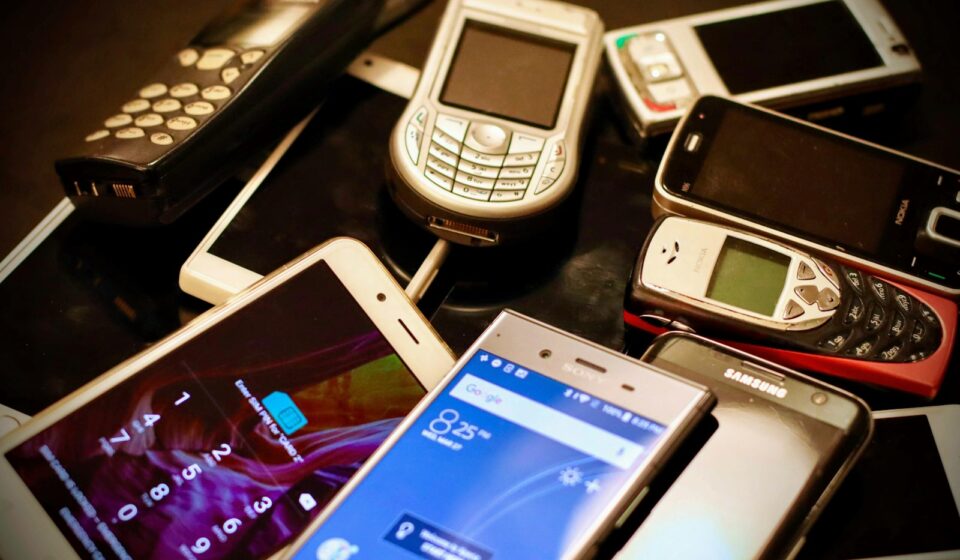
During this period, cell phones stopped being mere tools and morphed into fashion accessories. The form factors went wildly experimental. We saw candybar phones, clamshell flips, sliders that revealed hidden keyboards, and bizarre swivel designs that looked like switchblades. The hardware engineering was loud, weird, and incredibly fun.
The 2000s: The Awkward Teenage Years of Mobile Data
As we moved into the early 2000s, the industry obsessed over a new goal: putting the internet into your pocket.
It was a miserable slog.
I spent three weeks in a windowless server room in late 2001 trying to force a Nokia 7110 to pull a basic text weather update over an early WAP (Wireless Application Protocol) gateway. It was agonizing. We celebrated a 14-second page load like we’d just landed a rover on Mars.
WAP was an absolute failure. Carriers tried to build a walled-garden version of the internet, stripping away all images and formatting, leaving users with terrible, text-only menus that cost exorbitant amounts of money per kilobyte to browse. You’d accidentally press the dedicated internet button on your phone, panic, and frantically smash the ‘End Call’ button before the carrier charged you two dollars for a blank screen.
Despite the software failures, hardware continued to evolve. The Motorola RAZR V3, launched in 2004, pushed the limits of physical engineering. It was impossibly thin, made of aircraft-grade aluminum, and featured a chemically etched keypad. It sold over 130 million units.
Meanwhile, a Canadian company called Research In Motion (RIM) was quietly addicting the corporate world to the BlackBerry. By adding a full physical QWERTY keyboard and highly secure, push-based email servers, they created a device that executives literally could not put down. The term “CrackBerry” wasn’t just a joke; it was a highly accurate description of the dopamine loop created by that blinking red LED notification light.
2007: The Great Reset
Everything changed on January 9, 2007.
Steve Jobs walked onto a stage in San Francisco and announced the iPhone.
It is easy to look back now and think the iPhone’s success was inevitable. It wasn’t. At the time, the industry giants scoffed at it. Steve Ballmer, the CEO of Microsoft, famously laughed at the iPhone’s $500 price tag and its lack of a physical keyboard, claiming it would never appeal to business customers.
What Apple understood—and what Nokia, BlackBerry, and Motorola entirely missed—was that the physical keyboard was a prison.
If you hardcode a plastic keyboard onto the bottom half of a device, that space is completely useless when you want to watch a video, look at a map, or browse a photo. By removing the physical keys and utilizing a multi-touch capacitive glass screen, the iPhone became a fluid, shape-shifting piece of glass. It was a keyboard when you needed to type, a steering wheel when you played a racing game, and a massive viewfinder for the camera.
The introduction of the App Store a year later in 2008 was the final nail in the coffin for the old guard. The cell phone was no longer a telephone. It was a highly powerful, pocket-sized supercomputer that just happened to have an app that could make voice calls.
The Generational Blueprint: From 1G to 5G
To truly understand how rapidly this technology compounded, you have to look at the network generations side-by-side. The hardware in your hand is useless without the invisible radio waves bouncing between towers.
Here is exactly how the infrastructure evolved over the last forty years:
| Generation | Decade | Core Technology | Primary Capability | The Real-World Impact |
|---|---|---|---|---|
| 1G | 1980s | Analog (AMPS) | Basic Voice Calls | Incredibly expensive, heavy devices. Poor battery life. Zero security; calls easily intercepted by scanners. |
| 2G | 1990s | Digital (GSM/CDMA) | Voice & SMS Texting | Introduced SIM cards, secure encrypted calls, and the 160-character text message. Phones became pocket-sized. |
| 3G | 2000s | Packet Switching (UMTS/EV-DO) | Mobile Web & Email | The beginning of the smartphone era. Allowed for basic web browsing, photo sharing, and reliable push email (BlackBerry era). |
| 4G LTE | 2010s | IP-based Mobile Broadband | Video Streaming & Apps | Created the modern app economy. Uber, Instagram, and mobile Netflix only exist because 4G provided massive, reliable bandwidth. |
| 5G | 2020s | Millimeter Wave & Sub-6GHz | Ultra-Low Latency & IoT | Gigabit speeds. Designed not just for phones, but for connecting self-driving cars, smart cities, and augmented reality hardware. |
How This History Affects Your Buying Decisions Today
Why does any of this historical context matter to you right now?
Because understanding the friction of the past is the only way to see through the heavy marketing spin of the present. Tech companies spend billions of dollars trying to convince you that every minor iterative update is a massive, life-altering event. It rarely is.
If you want to stop wasting money on unnecessary upgrades, you need to apply what I call the Hardware Cycle Assessment Protocol (HCAP). It’s a very simple, intensely practical framework based entirely on how mobile technology actually evolves.
Step 1: Identify the Core Bottleneck
In the 1980s, the bottleneck was battery chemistry. Nickel-Cadmium (NiCd) batteries suffered from a “memory effect.” If you didn’t fully discharge the battery before plugging it in, the battery would permanently forget its true capacity, rapidly degrading its lifespan. The shift to Lithium-Ion (Li-ion) in the 90s solved this.
Today, the bottleneck isn’t the battery or the processor speed. Modern flagship processors (like Apple’s A-series or Qualcomm’s Snapdragon) have been vastly overpowered for daily tasks for at least five years. The current bottleneck is thermal management and battery degradation over time. Do not upgrade because a new phone is “20% faster.” You won’t feel that speed while scrolling social media. Upgrade only when your current battery physically degrades past 80% maximum capacity and replacing the battery itself is no longer cost-effective.
Step 2: Ignore the Camera Megapixel Myth
We saw this exact same marketing trick in the 2000s with screen resolutions. Companies pushed higher and higher pixel counts on tiny screens until human eyes literally couldn’t tell the difference (anything above 300 pixels per inch is generally indistinguishable at standard viewing distance).
They are doing it now with cameras. A 200-megapixel sensor on a smartphone is mostly a marketing gimmick. The physical lens is too small to capture enough light to make those pixels meaningful without aggressive software processing. Instead of looking at megapixels, look at sensor size and computational photography software. If your current phone takes photos you are happy with, a newer lens will not change your life, right?
Step 3: The “Tick-Tock” Upgrade Rule
Look back at the history. The DynaTAC was the “Tick” (the massive shift). The MicroTAC was the “Tock” (the refinement). The original iPhone was a Tick. The iPhone 3G with the App Store was the Tock.
Never buy the first generation of a radically new form factor. When folding screen phones hit the market a few years ago, early adopters paid a massive premium to act as beta testers for fragile hinges and peeling screens. Let the early adopters suffer the pain of the “Tick.” Always buy the “Tock”—the third or fourth generation of a hardware design, where the manufacturing flaws have been ironed out and the price has stabilized.
The Invisible Architecture of Modern Life
Think about what a modern smartphone actually is.
It is a high-definition television, a massive library, a professional-grade camera, a GPS navigation unit, an arcade, a bank, a flashlight, and a global communication device, all fused into a piece of glass and titanium less than a third of an inch thick.
It is incredibly easy to take this for granted. We get annoyed when a web page takes three seconds to load while we are sitting on a train hurtling through a tunnel at sixty miles an hour. But when you step back and look at the sheer, unadulterated engineering violence it took to get us here—from 80-pound trunk radios to Martin Cooper standing on that windy corner in Manhattan, to the agonizing software limitations of the early 2000s—you realize that the cellphone isn’t just an invention.
It’s a relentless, fifty-year war against the laws of physics.
Every time you drop your phone onto a wireless charging pad, you are interacting with the end result of decades of corporate espionage, brilliant breakthroughs, billion-dollar gambles, and countless failed prototypes.
The next time you hold your phone, actually look at it. Feel the weight of it. It doesn’t weigh two and a half pounds anymore. It doesn’t cost eleven thousand dollars. But the ghost of that original beige brick is still in there, quietly powering every single text, call, and swipe you make.