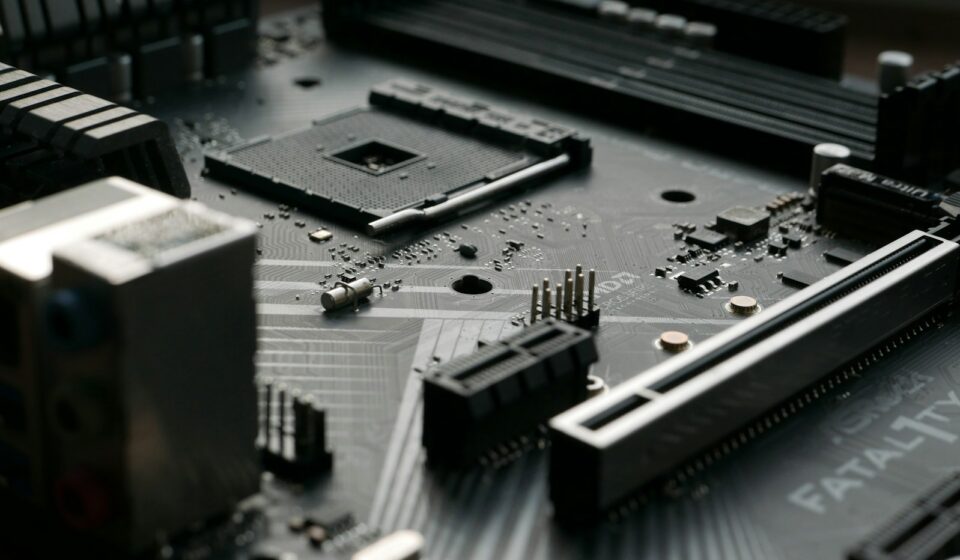

You’re staring at a dark, dusty rectangular void, clutching a brand new Gen4 NVMe SSD, and a cold sweat breaks out. You just realized you have absolutely no idea what motherboard is bolted to the inside of your PC case. Does it even support Gen4 speeds? Does it have an extra M.2 slot hidden under a chunky metal heatsink, or are you about to spend the next three hours unscrewing your graphics card for nothing?
Look, we have all been there.
Back in 2018, I nearly bricked a rather expensive Asus board because I tried flashing a BIOS update meant for the “Wi-Fi” variant of the exact same model. The names were identical save for two letters slapped onto the end of a very long string of alphanumeric soup. I caught my mistake at the absolute last possible second—literally hovering my mouse over the “Execute” button in the EZ Flash utility. That near-miss taught me a harsh lesson about hardware identification. You cannot guess this stuff. You have to know.
Your motherboard is the central nervous system of your entire computer. Every single electrical impulse, every data transfer, every peripheral you plug in relies entirely on that slab of silicon and fiberglass to talk to the rest of the machine. If you want to upgrade your RAM, swap out your CPU, or just update your BIOS to fix a weird USB dropout issue, you need the exact make and model number.
Lucky for you, finding out what motherboard you have is actually pretty easy once you know where to look. You rarely even need a screwdriver. We are going to rip through the fastest, most reliable ways to pull this information directly from your operating system, explore a few third-party lifesavers, and cover exactly what to do if your computer is completely dead and you are forced to go digging around inside the chassis with a flashlight.
The Absolute Fastest Way: Windows System Information
If your PC actually turns on and boots into Windows, you hold a massive advantage. Microsoft baked a deeply nerdy little tool into the OS decades ago, and it still works flawlessly for this exact problem.
It goes by the name msinfo32.
You don’t need to download anything. You don’t need administrator privileges. You just need your keyboard. Press the Windows key, type exactly System Information, and hit Enter. A decidedly old-school, spreadsheet-looking window will pop up on your screen.
This is your System Summary. Look down the list on the right-hand side. You are hunting for three specific lines:
- BaseBoard Manufacturer: This tells you who physically made the board (e.g., ASUSTeK COMPUTER INC., Micro-Star International Co., Gigabyte, ASRock).
- BaseBoard Product: This is the golden ticket. This is your exact model number (e.g., ROG STRIX B550-F GAMING, MAG Z790 TOMAHAWK WIFI).
- BaseBoard Version: Usually, this just says “Rev 1.0” or something similar. It matters occasionally if a manufacturer quietly released a physically updated version of the same board midway through its lifespan.
Simple as that. You have your answer.
Except when you don’t.
Here is the friction point that trips up so many people. Sometimes, you open up System Information, track down the BaseBoard Product line, and it just says, “To be filled by O.E.M.”
Infuriating, right?
This happens constantly with pre-built computers from massive companies like Dell, HP, or Lenovo. They often use proprietary boards with custom BIOS firmware that completely ignores standard Windows reporting protocols. Or, occasionally, a boutique system builder just forgot to input the system management data before shipping the rig out. If you are staring at a blank entry or a useless string of default text, do not panic. We just need to get a little more aggressive.
Getting Your Hands Dirty: The Command Line Approach
When the graphical interface fails you, it is time to drop into the terminal. Using the command line bypasses a lot of the superficial Windows fluff and queries the hardware directly through the Windows Management Instrumentation (WMI) infrastructure.
Hit the Windows key again, type cmd, and open the Command Prompt.
You are going to type the following string exactly as it appears here, with no extra spaces:
wmic baseboard get product,Manufacturer
Hit Enter. The terminal will spit back a neat little two-column output displaying your board maker and the model number. WMI is notoriously stubborn, which is exactly why I love it. It digs deep into the system registry and pulls the raw data the motherboard is broadcasting.
The PowerShell Alternative
Now, if you want to be incredibly pedantic—and in the tech world, who doesn’t?—you should know that Microsoft officially deprecated the WMIC command-line tool back in 2021. It still works on Windows 10 and most Windows 11 machines today, but eventually, it will vanish from the OS entirely.
If you want to future-proof your brain, use PowerShell instead.
Right-click your Start button, select Windows PowerShell (or Windows Terminal), and paste this command:
Get-CimInstance -ClassName Win32_BaseBoard | Format-Table Manufacturer, Product, SerialNumber, Version
This command does the exact same thing but uses the modern Common Information Model (CIM) cmdlets. I actually prefer this method because I threw the SerialNumber tag in there. If you ever need to RMA a dead motherboard back to Gigabyte or MSI, they will demand that serial number. Being able to copy-paste it directly from PowerShell instead of trying to read a tiny barcode sticker hidden under a dusty graphics card is a massive quality-of-life upgrade.
Third-Party Software: The Heavy Artillery
Let’s say you want more than just a model number. Maybe you need to know exactly what BIOS version you are currently running to see if you are patched against the latest security vulnerability. Or maybe you need to check the exact voltage running through your CPU socket.
Windows built-in tools are great for a quick glance, but they lack serious depth. For total diagnostic clarity, you need dedicated hardware monitoring software.
I have used dozens of these apps over the last fifteen years. Most of them are bloated trash. A few of them are absolute gold. Here is a breakdown of the only three tools you should ever consider installing for this job.
| Software Tool | Best Use Case | Why It Works | Cost |
|---|---|---|---|
| CPU-Z | Quick, clean, and lightweight identification. | It features a dedicated “Mainboard” tab that instantly displays your manufacturer, model, chipset, and exact BIOS version in a tiny, zero-fuss window. | 100% Free |
| HWiNFO64 | Deep-dive diagnostics and thermal monitoring. | The undisputed king of system info. It pulls data from every single sensor on your motherboard. It is overwhelming for beginners but unmatched for accuracy. | Free (Personal Use) |
| Speccy | Visual, beginner-friendly system overviews. | Created by the makers of CCleaner. It gives you a highly readable, colorful breakdown of your entire PC, including motherboard temps. | Free / Paid Pro Tier |
If you just want the answer right now, download CPU-Z. It comes as a portable zip file, meaning you don’t even have to formally install it. Extract the folder, run the executable, click the “Mainboard” tab at the top, and read the text in the “Model” box. You are done in thirty seconds.
The Pre-Boot Method: Diving into the BIOS/UEFI
What if you don’t have Windows installed yet? Or what if your system is trapped in a vicious boot loop, crashing before you ever see your desktop?
You have to go straight to the source. You have to enter the BIOS.
The BIOS (Basic Input/Output System), or UEFI as it is technically called on modern machines, is the localized firmware that lives on a tiny flash memory chip right on the motherboard itself. It wakes up all your hardware before handing control over to your operating system.
Getting into it requires a bit of timing.
Restart your computer. The second the screen goes black, start tapping the DEL key on your keyboard. Do not hold it down. Just tap it rapidly like you are playing an arcade game. Depending on your brand, the magic key might be F2, F12, or even ESC, but for 95% of custom-built PCs, it is the Delete key.
If you time it right, you will be greeted by a graphical interface. Modern UEFIs look like actual software programs—they have mouse support, fan curve charts, and aggressive red-and-black gamer aesthetics if you bought an Asus ROG or MSI board.
Right at the top of the main screen—usually branded as “EZ Mode” or “Main”—your motherboard model name will be plastered in large, unmistakable text. You will also see your current BIOS version right next to it. Snap a photo of this screen with your phone. Trust me. Having a reference photo of your BIOS version and motherboard model on your camera roll is incredibly handy when you are standing in a micro center trying to figure out if a new CPU will be compatible out of the box.
The Analog Approach: Physical Inspection
Alright, let’s paint a grim picture. The PC is dead. The power supply blew out, or the motherboard itself shorted. The machine will not turn on. No Windows. No terminal. No BIOS.
You have to open the case.
Unplug the power cable from the wall. Seriously, do not skip that step. Press the power button on the top of the case a few times to drain any residual electricity from the capacitors. Take off the glass side panel.
Grab a flashlight. Your phone light works perfectly.
Motherboard manufacturers are quite proud of their products. They almost always print the brand name and the specific model number directly onto the PCB (Printed Circuit Board) using bright white silkscreen paint. The problem isn’t that the text is missing; the problem is that your other components are probably covering it up.
Here are the four most common places to hunt for the model number:
1. Dead center, right below the CPU socket. This is prime real estate. If you have a large air cooler strapped to your processor, it might be casting a deep shadow over this area. Shine your light right between the heatsink fins and the first PCIe slot.
2. Between the PCIe slots. Look at where your graphics card plugs in. Often, the motherboard name is stamped right between the first and second long slots. If you have a massive, three-slot modern GPU, it will completely hide this text. You might actually have to unclip the GPU and gently pull it out to see the board clearly.
3. Next to the RAM slots. Look to the right of your processor, where those vertical sticks of memory sit. Sometimes, manufacturers run the model number vertically right alongside the main 24-pin power connector.
4. The Chipset Heatsink. Down in the bottom right quadrant of the board, there is usually a square metal block cooling the chipset. Often, the brand’s gaming logo is etched here, but occasionally they will print the model number right on the metal.
If you are dealing with an older, cheaper board, you might just find a tiny white sticker with a barcode and a jumble of letters. Look for a string that starts with a chipset identifier—something like B450, Z690, X570, or H610. That is your biggest clue.
What About Mac Users?
Apple does not use the word “motherboard.” They call it a “Logic Board.” And Apple, being Apple, deliberately obscures the specific hardware details from the end user because they really do not want you opening up your iMac or MacBook to tinker with the internals.
If you are on a Mac, finding your logic board model is basically just finding your exact Mac model identifier, because the two are inextricably linked. You cannot upgrade a Mac logic board independently anyway.
Click the tiny Apple icon in the top left corner of your screen. Select “About This Mac.”
Click on “More Info” (or “System Report” if you are on an older version of macOS).
Under the Hardware overview, you will see a “Model Identifier” (something like MacBookPro18,3). If you need to replace a dead logic board via a third-party repair shop, that identifier, combined with the serial number listed right below it, is exactly what the technician needs to source the replacement part.
The Linux Terminal Magic
If you are running Ubuntu, Mint, Arch, or any other flavor of Linux, you probably already know your way around a terminal. Linux makes hardware identification incredibly transparent, assuming you know the right commands.
Open your terminal and type:
sudo dmidecode -t 2
You will need to punch in your admin password. The dmidecode command reads the DMI (Desktop Management Interface) table directly. The -t 2 flag specifically filters the output to only show “Base Board” information.
Your screen will populate with the Manufacturer, Product Name, Version, and Serial Number. It is clean, instantaneous, and infinitely more reliable than poking around in graphical settings menus. If dmidecode isn’t installed for some reason, you can also cat the sysfs files directly by typing cat /sys/devices/virtual/dmi/id/board_name, which will just output the raw model string and nothing else.
Why Decoding the Name Matters
Okay, so you found it. You looked in the command prompt, and it says you have an MSI MAG B650 TOMAHAWK WIFI.
What does that actually mean? Motherboard names look like a cat walked across a keyboard, but they follow a very strict, highly logical naming convention. Breaking down this string tells you exactly what your computer is capable of without ever looking at a manual.
Let’s dissect it.
The Brand (MSI): The company that engineered and sold the board.
The Sub-Brand (MAG): This indicates the product tier. Asus has ROG (high-end) and TUF (budget). MSI has MEG (enthusiast), MPG (mid-range), and MAG (entry/value). This tells you roughly the build quality and VRM (Voltage Regulator Module) strength you are dealing with.
The Chipset (B650): This is the most crucial part of the entire name. The chipset dictates everything. The first letter (B) tells you it is a mainstream tier board. (An ‘X’ or ‘Z’ would mean high-end, while an ‘A’ or ‘H’ means budget). The numbers (650) indicate the generation. A B650 chipset is an AMD platform designed specifically for the AM5 socket. Just by reading “B650,” I instantly know this board supports Ryzen 7000 and 8000 series processors, uses DDR5 RAM, and supports PCIe Gen4 or Gen5.
The Model Name (TOMAHAWK): This is just marketing flair to differentiate it from other B650 boards MSI sells, like the “Mortar” or the “Edge.”
The Suffix (WIFI): It has a built-in wireless networking card. If it didn’t have this, you would have to plug in an Ethernet cable or buy a separate PCIe Wi-Fi card.
Once you learn how to read the chipset code, you hold the keys to the kingdom. If you find out you have a Z790 board, you immediately know you have an Intel socket LGA 1700 board capable of heavy CPU overclocking. If you see A320, you know you have an incredibly cheap, older AMD board with heavily restricted upgrade paths.
The OEM Trap: Dell, HP, and Proprietary Nightmares
I need to address the elephant in the room. If you bought an Alienware, an HP Omen, or a standard Dell OptiPlex office machine, your motherboard hunt is going to be incredibly frustrating.
These large manufacturers hate standard form factors. Instead of using standard ATX or Micro-ATX boards, they design weird, L-shaped motherboards that fit perfectly into their specific custom cases. They use proprietary power connectors—meaning a standard power supply from Best Buy literally will not plug into the board without sketchy adapter cables.
When you use the Command Prompt to find the motherboard model on a Dell, it usually spits back a random alphanumeric code like 0KWVT8.
If you google that, you won’t find a glossy product page. You will find sketchy eBay listings for replacement parts pulled from dead office PCs.
If you are trying to find your motherboard model on an OEM machine because you want to move the guts of your PC into a cooler, airflow-focused case, stop right now. It almost certainly will not fit. The mounting holes will not line up with standard case standoffs, and the front panel connectors (the tiny wires that make your power button work) are likely hardwired into a proprietary block.
For OEM machines, finding the motherboard model is really only useful if the board dies and you need to buy an exact 1-to-1 replacement off the secondhand market.
Putting Your New Knowledge into Action
So, you have the exact model number written down on a sticky note. What next? How does this actually solve your problem?
Your next step is to open a web browser, type your exact motherboard model into the search bar, and go directly to the manufacturer’s official support page. Ignore the Amazon listings. Ignore the Reddit threads for a second. Go straight to Asus, Gigabyte, MSI, or ASRock’s website.
Once you are on the specific product page for your exact board, you want to navigate to the “Support” or “Downloads” section. This page is a goldmine. It contains three critical documents that govern your PC’s life.
1. The CPU Support List. Thinking about upgrading your processor? You must check this list first. Just because a new CPU physically fits into your motherboard socket does not mean the motherboard knows how to talk to it. Often, you need to update the BIOS before dropping in a newer generation CPU. The CPU support list will tell you exactly which BIOS version is required for every single processor compatible with your board.
2. The QVL (Qualified Vendor List) for Memory. RAM is incredibly finicky. If you buy a kit of high-speed DDR5 memory and just slap it in, it might crash your system constantly. Motherboard makers test hundreds of specific RAM kits and publish a QVL. If the exact serial number of the RAM you want to buy is on that list, it is guaranteed to run at its advertised speed perfectly. If it isn’t on the list, you are rolling the dice.
3. The Manual. Download the PDF manual. Keep it on your desktop. When you are trying to figure out which M.2 slot shares bandwidth with your SATA ports, or you need to know exactly which two pins to short with a screwdriver to clear the CMOS and reset your BIOS, that PDF will save your life. You can just hit CTRL+F and search exactly what you need.
Hardware isn’t magic. It is just a highly organized set of rules built into silicon. The moment you identify the exact foundation your system is built upon, you strip away the mystery. You stop guessing what components might work and start making deliberate, informed decisions. Whether you are typing a WMI string into a black terminal window, installing a monitoring app, or shining a flashlight onto a dusty green circuit board, finding your motherboard model is the very first step to actually owning your hardware, rather than just using it.